Why Skills-Based Hiring is Stalling: New University of Phoenix Career Institute® Report Finds Employers Aren't Set Up for Success
PR Newswire
PHOENIX, March 2, 2026
Employers want skills-first hiring—but without consistent standards, training, and tools, effective skills evaluation still isn't happening at scale.
PHOENIX, March 2, 2026 /PRNewswire/ -- University of Phoenix Career Institute® today released its latest installment in The Career Optimism Special Report™ Series: The Illusion of Progress in Skills-Based Hiring, finding that while skills-based approaches are gaining in momentum, many employers still lack clear standards and consistent tools to evaluate candidates' skills effectively.
Although 82% of hiring stakeholders say their organization's hiring process is shifting toward a more skills-based approach, 53% of employers report a lack of standardized hiring practices, and 57% of hiring stakeholders say they need better training to evaluate candidates' skills—highlighting a gap between intent and implementation. The result is a hiring system in limbo, where an illusion of progress towards skills-based models is fueling dysfunction across the talent pipeline.
This comes as job applications surge—up 31% last year, far outpacing the 7% growth in openings—with AI tools making it easier to apply en masse, according to Workday's Global Workforce Report. But with job openings flatlining at the end of 2025 (per the latest JOLTS data), both hiring teams and job seekers are feeling the squeeze: more résumés, less clarity, and mounting pressure on systems never built for this scale.
Key Findings
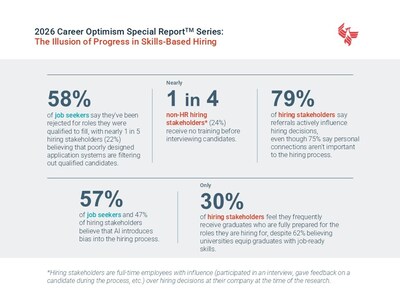
- Skills Lost in Translation: 22% of hiring stakeholders say poorly designed application systems may be filtering out good candidates—helping to explain why 58% of job seekers say they're being rejected despite being qualified for a role. Even when candidates have the right capabilities, 48% of hiring stakeholders admit they can still miss out simply because these candidates struggle to demonstrate their skills clearly in the hiring process.
- Referrals Still Rule: Despite 3 in 4 hiring stakeholders (75%) saying personal connections aren't important to the hiring process, 79% admit that final hiring decisions are influenced by personal referrals.
- AI Is Creating a Trust Divide: 57% of job seekers and 47% of hiring stakeholders believe AI introduces bias into the hiring process—yet just 1 in 3 companies (37%) audit their tools for this.
- The Manager Training Gap: 1 in 4 non-HR hiring stakeholders (24%) receive no training before interviewing job candidates—yet many own the final hiring call.
"Skills-based hiring can be a powerful driver of economic mobility and can help employers access overlooked talent—but only if intent and infrastructure are aligned," says Alison Lands, VP of Employer Mobilization at Jobs for the Future. "That means measuring and hiring for what predicts success on the job, supported by clear standards and consistent evaluation."
The Stakes
"The Illusion of Progress in Skills-Based Hiring reveals a hiring ecosystem looking to evolve while struggling to keep pace with rising expectations. Employers want to prioritize skills—but without consistent training, clear standards, or unbiased tools, the process risks becoming even more opaque," says Cheryl Naumann, Chief Human Resources Officer, University of Phoenix. "At University of Phoenix, we're at the start of that journey as well, which is why we launched this report – to understand the landscape where progress is being made, where critical gaps remain, and what it will take to make skills-based hiring work in practice. There's a real opportunity for business and education to align on the frameworks needed to make skills-first hiring a reality, and we're committed to continuing this important dialogue while preparing our students with the skills to thrive in today's talent market, including how to market their skills effectively."
The Call-to-Action
- C-Suite: Redefine what 'qualified' means. Build hiring systems that match internal training—and avoid leaving talent behind.
- HR: Empower stakeholders with consistent tools and lead the charge on structure, not just compliance.
- Higher Ed: Hardwire real-world experience and adaptability into every program and help your grads articulate relevant hard and soft skills.
- Job Seekers: Lead with your hard and soft skills to demonstrate what you've built, learned, and solved—even outside traditional learning paths—to make sure you aren't overlooked.
Download the complete whitepaper at https://www.phoenix.edu/career-institute.html.
ABOUT THE CAREER OPTIMISM SPECIAL REPORT™ SERIES: THE ILLUSION OF PROGRESS IN SKILLS-BASED HIRING
The Career Optimism Special Report™ Series: The Illusion of Progress in Skills-Based Hiring compromised of a 20-minute online survey conducted among 2,000 U.S. adults in two categories including n=1,000 Job Seekers and n=1,000 Hiring Stakeholders. Job Seekers were U.S. adults (ages 18 and up) who were recently hired or actively seeking employment at the time of research and Hiring Stakeholders were U.S. adults (ages 25 and older) who were employed full-time and had influence (participated in an interview, gave feedback on a candidate during the process, etc.) over hiring decisions at their company at the time of the research. Fieldwork was conducted from June 2–13, 2025.
The survey was designed to assess the state of the hiring process, the direction it's headed, and the barriers that get in the way, both for candidates trying to break through and hiring managers trying to find the right talent. The quantitative survey was supplemented with 10 qualitative one-on-one video interviews with Hiring Stakeholders from the survey respondents who agreed to be recontacted for additional research.
ABOUT UNIVERSITY OF PHOENIX CAREER INSTITUTE®
Housed within the university's College of Doctoral Studies, the Career Institute conducts impactful research and collaborates with leading organizations to explore broad and persistent barriers to career growth. Through annual studies like the Career Optimism Index® and targeted reports, the Institute shares actionable insights to inform solutions. For more information, visit www.phoenix.edu/career-institute.
ABOUT UNIVERSITY OF PHOENIX
University of Phoenix innovates to help working adults enhance their careers and develop skills in a rapidly changing world. Flexible schedules, relevant courses, interactive learning, skills-mapped curriculum for our bachelor's and master's degree programs, and a Career Services for Life® commitment help students more effectively pursue career and personal aspirations while balancing their busy lives. For more information, visit phoenix.edu.
 View original content to download multimedia:https://www.prnewswire.com/news-releases/why-skills-based-hiring-is-stalling-new-university-of-phoenix-career-institute-report-finds-employers-arent-set-up-for-success-302701603.html
SOURCE University of Phoenix