Vectris Discovers Recoverable AI Compute Capacity Inside Deployed GPUs, Demonstrating Up to 73% More Productive Capacity
PR Newswire
BIRMINGHAM, Ala., Aug. 20, 2026
Waveform captures previously unrecovered capacity across NVIDIA H100, H200 and B200 infrastructure, with Vectris testing showing 30–73% higher throughput, 51–56% lower energy consumption and 22–42% faster workload completion.
BIRMINGHAM, Ala., Aug. 20, 2026 /PRNewswire/ -- Vectris Labs today announced the discovery of deterministic structural patterns in AI inference that reveal recoverable compute capacity inside GPUs already deployed. The company has built Waveform, a control plane designed to capture that capacity and turn it into additional productive AI output—without retraining models, changing model weights or modifying GPU kernels.
WHY THIS MATTERS
AI infrastructure is entering a new phase. As demand for inference grows, the economics of AI increasingly depend not simply on how many GPUs an organization deploys, but on how much useful output those GPUs can produce within fixed constraints of power, capital and time.
Vectris calls this economic control point Compute Yield™: the amount of quality-equivalent accepted AI output produced from existing compute infrastructure. In practical terms, Waveform is designed to make existing GPU infrastructure produce more useful AI work without requiring additional GPUs or changes to the models.
THE DISCOVERY
Vectris' work began with the observation that what appears irregular inside AI computation contains deterministic structural patterns that reveal where productive capacity is being lost. The company says those patterns make recoverable GPU capacity measurable, governable and capturable.
"We didn't impose this structure on the computation—we discovered it was already there. The patterns are deterministic, and once we understood them, recoverable GPU capacity became something we could measure, govern and capture", Said Vinod Tipparaju, Co-founder and Chief Technology Officer, Vectris Labs, "Compute Yield™ is the economic expression of that discovery—how much useful AI output we can produce from the infrastructure already in place."
THE PROOF
Waveform has now been tested across third-party NVIDIA, AMD and Intel silicon, providing cross-silicon evidence that the control plane is not confined to a single GPU vendor or architecture. Quantified results have been demonstrated on NVIDIA and Intel platforms.
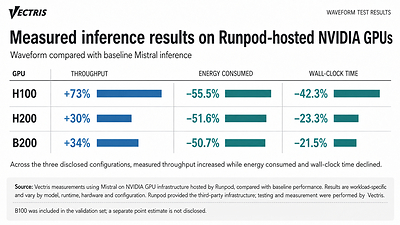
On commercially available NVIDIA H100, H200 and B200 GPUs in third-party RunPod infrastructure, Waveform increased productive GPU capacity on Mistral workloads while reducing both energy consumption and wall-clock time. No model retraining, model-weight changes or GPU-kernel modifications were required.
At the conservative +30% low end of the measured NVIDIA throughput range, a 10,000-GPU fleet operating at the same uplift would produce baseline-equivalent throughput comparable to 13,000 GPUs - the equivalent of 3,000 GPUs of additional productive capacity without expanding the physical fleet. This is an illustrative extrapolation, not a measured 10,000-GPU deployment.
Measured inference results on Runpod-hosted NVIDIA GPUs*
Waveform compared with baseline Mistral inference
|
GPU / Workload |
Throughput |
Energy Consumed |
Wall-Clock |
|
H100 / Mistral |
+73 % |
-55.5 % |
-42.3 % |
|
H200 / Mistral |
+30 % |
-51.6 % |
-23.3 % |
|
B200 / Mistral |
+34 % |
-50.7 % |
-21.5 % |
*Validation Note: Performance figures are Vectris-measured Mistral results on commercially available NVIDIA H100, H200 and B200 GPUs in RunPod infrastructure and are workload- and configuration-specific. They have not yet been independently reproduced in customer production.
ARCHITECTURE-AGNOSTIC VALIDATION
On third-party Intel silicon, Waveform demonstrated 67% energy savings and a 32% reduction in time-to-result using the MLPerf LoadGen benchmark. Waveform has also been tested on third-party AMD silicon.
For operators, the evidence translates directly into capacity, cost and time: more useful AI output from installed infrastructure, less energy required to produce the work, and faster release of infrastructure for additional workloads.
WHAT WAVEFORM DOES
Waveform turns the discovery into an operational control point for AI infrastructure. It does not replace the optimized inference stack; it adds a control layer between serving infrastructure and the GPU, continuously identifying structural waste and reorganizing inference execution in real time.
The result is intended to complement existing inference infrastructure while targeting recoverable computational capacity that remains after conventional optimization. The objective is straightforward: more useful AI output from the infrastructure already deployed.
COMPUTE YIELD™
Vectris defines Compute Yield™ as the amount of quality-equivalent accepted AI output produced from existing compute infrastructure. It captures how efficiently installed infrastructure turns GPU capacity, energy and time into accepted AI output.
The company believes Compute Yield™ can become a new control point for AI infrastructure economics as operators increasingly balance compute availability, power constraints, capital investment and workload demand.
Vectris has completed technical demonstrations with AI-infrastructure and channel leaders and engaged a data-center advisory network representing approximately 300 MW of capacity.
COMMERCIAL AVAILABILITY
Waveform will launch October 1, 2026, with initial availability to a limited number of design partners. The company is moving from real-GPU proof toward commercial deployment.
THE BROADER AI INFRASTRUCTURE OPPORTUNITY
Vectris sees GPU inference as the first commercial application of its framework, not its endpoint. With Waveform now tested across NVIDIA, AMD and Intel silicon, the next frontier is to determine how far the same control principles extend across the broader AI infrastructure stack—including memory, data movement, networking, distributed compute, power and thermal systems. If validated across those domains, Waveform could become a broader control layer for the AI factory.
"The next phase of American leadership in artificial intelligence will depend not only on how much infrastructure we can build, but on how much more productive we can make the infrastructure already in place", said Innovate Alabama Chairman Bill Poole, "The constraints around power, capital and compute are structural, and meeting exponential AI demand will require extracting greater value from every deployed system. Vectris is tackling that challenge from Birmingham with technology designed to increase the productive capacity of existing AI infrastructure—a powerful example of how consequential innovation from Alabama can address a problem of national economic and strategic importance."
ABOUT VECTRIS LABS
Vectris Labs, Inc. is a Birmingham, Alabama-based AI infrastructure company behind Waveform, a control plane for Compute Yield™ in AI inference.
The Vectris team brings deep experience across GPU systems, AI infrastructure, cloud computing, performance engineering and large-scale computing environments, with backgrounds spanning AMD, Graphcore, Oracle Cloud Infrastructure, ByteDance, Mercedes-Benz, the U.S. Department of Energy and Oak Ridge National Laboratory.
That experience in understanding how computation behaves at the hardware and systems level led directly to Vectris' discovery of deterministic structural patterns in AI inference—and to the development of Waveform as a way to measure, govern and capture the productive GPU capacity those patterns reveal.
Vectris was conceived and incubated in Birmingham by Thumos Capital. For additional information visit vectrislabs.ai. Book a Demo here.
MEDIA CONTACT
Melanie McCraney
melanie@mccraneypr.com
*VALIDATION AND DISCLOSURE
Performance figures are Vectris-measured Mistral results on commercially available NVIDIA H100, H200 and B200 GPUs in RunPod infrastructure and are workload- and configuration-specific. They have not yet been independently reproduced in customer production. The 10,000/13,000-GPU example is illustrative, not a measured fleet deployment. Third-party names do not imply endorsement. Quotes, titles and public references remain subject to approval before publication.

 View original content to download multimedia:https://www.prnewswire.com/news-releases/vectris-discovers-recoverable-ai-compute-capacity-inside-deployed-gpus-demonstrating-up-to-73-more-productive-capacity-302855697.html
SOURCE Vectris Labs