TELUS Mental Health Index: Cost-of-living is the number one financial stress for 63 per cent of workers in Canada as financial anxiety hits workplace productivity
Canada NewsWire
VANCOUVER, BC, Sept. 1, 2026
A new Q2 2026 report highlights critical workplace mental health trends, revealing sixty per cent of Canadian workers don't understand their retirement benefits, while 27 percent feel unsafe disclosing mental health issues to managers.
Quick Facts:
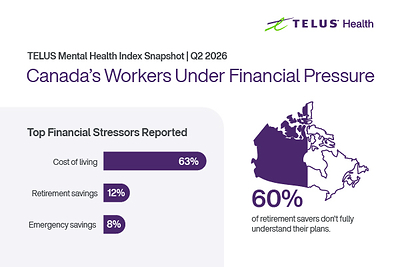
- Cost of living is the top financial stressor for 63 percent of workers, dwarfing those concerned about retirement savings (12 percent) and emergency savings (8 percent)
- More than half (60 percent) of workers in Canada don't fully understand the retirement or savings plan they pay into
- The Index reveals a stark link between employee financial wellbeing and overall productivity, as one in five workers in Canada say money stress is negatively affecting their workplace productivity
- Thirty-five per cent of workers in Canada are anxious about money, and nearly one in eight never stop worrying about their finances
VANCOUVER, BC, Sept. 1, 2026 /CNW/ -- Today, TELUS Health released its TELUS Mental Health Index ("the Index") reporting that 63 per cent of Canada's workers identify cost of living as their primary financial stressor; one in five employees report financial worry has directly impaired their productivity at work; and those under 40 years old, working parents, and managers feel it the most. Adding to these financial anxieties, a benefits understanding gap finds 60 per cent of workers in Canada do not fully understand the retirement plan they pay into each month, and 63 percent want more employer-provided resources, communications, or support for retirement, pensions, or savings plans.
Financial anxiety directly impacts workplace productivity
The economic pressures are being felt, as 63 per cent of employees cite the cost of living as their primary source of financial anxiety, far outpacing concerns over retirement savings (12 per cent) or emergency savings (8 per cent). Thirty-five per cent of Canadian workers feel worried or anxious about their finances, while twenty per cent of employees report that financial stress directly hurts their workplace productivity, with five per cent missing work entirely due to financial anxiety.
The cost of living pressures compound as twenty-eight per cent of Canadian employees lack emergency savings to cover basic needs. Workers without emergency savings are nearly three times more likely to report impaired work productivity and score 20.6 points lower according to the Index (49.1 vs. 69.7). Further compounding these financial stressors is the benefits and savings knowledge gap, as 60 per cent of workers who contribute to a workplace retirement or savings program don't fully understand how it works, as 63 percent want more employer-provided resources and support for retirement, pensions, or savings plans.
Younger workers, parents, and caregivers carry disproportionate burden
Demographic analysis shows stark differences in how financial stress impacts employee mental health across age, family structure, and sector groups.
- Age: Workers under age 40 are three and a half times more likely than those over 50 to report that financial stress negatively affects their work productivity.
- Family: Parents are 80 per cent more likely to report productivity losses due to financial strain compared to their counterparts.
- The 'Sandwich Generation': Twenty-seven per cent of Canada's workforce provides financial support or caregiving to adult children (15 per cent) or aging parents (12 per cent). Among these caregivers, 37 per cent report a negative impact on their finances, 32 per cent on their mental health, and 15 per cent on work productivity.
Overcoming the savings and benefits knowledge gap to protect productivity
"We have a strong opportunity to support each generation with the unique challenges they face every day, outside and within the workplace," said Paula Allen, Global Leader of Research and Insights, TELUS Health. "When 60 per cent of employees contributing to a workplace pension or retirement plan do not fully understand how it works, employers lose the return on investment of their total rewards spend. By offering accessible financial literacy resources and direct financial coaching, organizations can relieve financial anxiety, lower absenteeism, and improve workforce engagement."
The report found those with no understanding of their pension or retirement plan score 19.3 points lower on their mental health score. Notably, 63 per cent of employees actively want employer-provided resources or support for retirement and savings plans, which is the most requested category of help in the study.
The impact of mental health stigma on employee disclosure and care
Beyond economic pressures, workplace stigma remains a significant barrier to care. Less than half of employees (49 per cent) feel safe discussing mental health concerns with leadership. Furthermore, while substance use negatively impacts performance for 24 per cent of affected workers, primary obstacles to treatment include embarrassment (27 per cent), financial costs (23 per cent), privacy concerns (22 per cent), and the threat of career consequences (22 per cent).
About the TELUS Mental Health Index research methodology
The TELUS Mental Health Index data was gathered through an online survey conducted between June 5 and June 18, 2026, among 3,000 employed adults in Canada who were employed within the previous six months. Sample selection reflects the age, gender, industry, and geographic distribution of the Canadian working population. Benchmark comparisons evaluate scores out of 100 based on optimal (80–100), strained (50–79), and distressed (0–49) ranges.
Frequently Asked Questions
Q: How is the cost of living impacting employee mental health in Canada?
Cost of living is the number one driver of financial anxiety for 63 per cent of Canadian workers, driving an MHI sub-score of 56.6 that sits more than seven points below the national average. Day-to-day inflation and everyday expenses outweigh concerns over long-term wealth building, leading to elevated stress (37 per cent), sleep disruption (27 per cent), and reduced workplace engagement (18 per cent).
Q: What is the link between financial stress and employee productivity?
Twenty per cent of Canadian workers report that financial stress has directly hurt their productivity at work, with this group scoring 24.4 points lower on the Index than unaffected peers (47.3 vs. 71.7). Financial anxiety creates continuous operational distractions, leading to difficulty concentrating (14 per cent), lower work engagement (18 per cent), and increased absenteeism (5 per cent).
Q: What percentage of workers are anxious about money?
Sixty-nine per cent of Canadian workers feel worried or anxious about their financial situation at least sometimes, with 35 per cent feeling anxious always or often. The 12 per cent of employees who "always" feel anxious about money record an MHI score of 39.5—the lowest score in the entire report and 24.4 points below the national benchmark.
Q: How many employees are missing work due to financial stress?
Five per cent of Canadian workers have missed work entirely due to financial stress, recording an MHI score of 45.3—nearly 19 points below the national average. This demonstrates that financial anxiety directly drives unscheduled leave, creating a measurable attendance issue for C-suite leaders.
Q: Do Canadian employees understand their workplace retirement and savings plans?
Sixty per cent of Canadian workers contributing to workplace retirement or savings programs do not have a strong understanding of how they work. Employees who report no understanding at all score 19.3 points lower on the Mental Health Index than those who understand their plans well.
Q: What financial wellbeing benefits do Canadian workers actually want from employers?
Sixty-three per cent of Canadian employees want employer-provided resources, communications, or support for retirement, pensions, and savings plans—making it the most requested category of financial support. Additionally, workers seek support for investing (21 per cent), tax planning (18 per cent), emergency savings (16 per cent), and debt management coaching (15 per cent).
Q: How does caregiving for adult dependents affect employee financial health?
Twenty-seven per cent of Canadian workers financially support or care for adult children (15 per cent) or aging parents (12 per cent), with 37 per cent of these caregivers reporting a negative impact on their finances. Furthermore, 32 per cent report a negative impact on their mental health, recording an MHI score of 48.2—nearly 16 points below the national benchmark.
Q: How many employees lack emergency savings?
Twenty-eight per cent of Canadian workers lack emergency savings to cover basic needs. Workers without an emergency safety net record an MHI score of 49.1 (vs. 69.7 for those with savings) and are nearly three times more likely to report that financial stress has damaged their work productivity.
Q: Are employees comfortable discussing mental health with their manager?
Only 49 percent of workers in Canada feel comfortable telling their manager if they have a mental health issue, while 27 percent would not feel comfortable and 24 percent are unsure. Workers who would not feel comfortable disclosing a mental health issue score 14 points lower on the Index compared to those who would (54.7 vs. 68.7).
Q: What stops employees from getting help for substance use?
Top barriers preventing workers in Canada from seeking help for substance use include stigma or embarrassment (27 percent), cost or financial barriers (23 percent), confidentiality concerns (22 percent), and fear of having to tell someone at work (21 percent). Additionally, 21 percent of workers prefer to handle substance use issues on their own.
Q: What is the state of workplace mental health in Canada in 2026?
The Index score stands at 63.9 and the mental health of workers improved by nearly one point from the first quarter of 2026 in Canada. Thirty-three per cent of workers have a high mental health risk, 45 per cent have a moderate mental health risk, and 22 per cent have a low mental health risk. Anxiety (56.1) and isolation (59.2) remain the lowest sub-scores in the report, continuing as the primary drivers of workforce psychological risk.
About TELUS Health
TELUS Health empowers people to live healthier lives and helps organizations create more productive, wellbeing-focused workplaces through global leadership in healthcare technology. Operating in more than 200 countries and territories, we support approximately 159 million people at every point of their physical, mental, and financial wellbeing journey.
Our integrated approach connects the entire healthcare ecosystem: comprehensive workforce wellbeing programs, compassionate and personalized preventive care, and the technology infrastructure that healthcare practitioners and payors rely on daily. This creates seamless care pathways delivering regionalized and gender-responsive support, where and when people need it most.
Through our data-driven insights and proprietary research we are reshaping healthcare with earlier intervention and culturally-attuned approaches so individuals and organizations can thrive. Follow us as we advance our mission to become the world's most trusted wellbeing company: telushealth.com.
Media Contact:
Kaya Arai
TELUS Health PR
kaya.arai@telus.com

SOURCE TELUS Health