Rehab Therapists Will Lose Nearly Five Years of Their Careers to Documentation, New Ensora Health Research Finds
PR Newswire
BIRMINGHAM, Ala., July 9, 2026
A national survey of more than 500 speech-language pathologists, physical therapists, and occupational therapists, reveals a 49-point gap between the clinicians who see AI as the answer to documentation and those who trust it enough to use it. Burnout is near-universal at 86%, and a widening divide is separating the practices pulling ahead from those in survival mode.
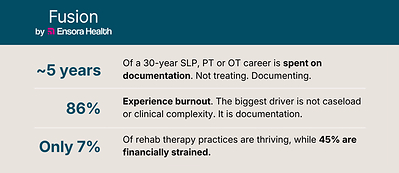
BIRMINGHAM, Ala., July 9, 2026 /PRNewswire/ -- Over a 30-year career, the average rehab therapist spends the equivalent of nearly five years on documentation. Not treating patients. Documenting care.
That figure anchors The Practices Pulling Ahead, a new national report from Ensora Health built on more than 33,000 data points from a 32-question survey of over 500 licensed speech-language pathologists (SLPs), physical therapists (PTs), and occupational therapists (OTs) across the United States. The report was designed to measure the pressures reshaping rehab therapy and, more importantly, to identify what separates the practices gaining ground from those simply trying to survive.
By the numbers
- Rehab therapists will spend nearly 5 years of a 30-year career on documentation, not treating patients. (Ensora Health, 2026)
- 70% of rehab therapists see AI's biggest value in documentation; only 21% use it that way, a 49-point trust gap. (Ensora Health, 2026)
- 1 in 6 therapy practices (16%) say reimbursement pressure has directly compromised patient care. (Ensora Health, 2026)
- Just 7% of therapy practices are thriving, while 45% are financially strained. (Ensora Health, 2026)
- 86% of rehab therapists report burnout; 59% name documentation as the top driver. (Ensora Health, 2026)
Clinicians can see exactly what documentation is costing their own practice using the report's interactive documentation cost calculator, open to everyone at http://insight.ensorahealth.com/future-of-rehab-therapy/.
The AI trust gap: clinicians want it, but don't believe it yet
The report's most actionable finding is a striking disconnect: 70% of rehab therapists see AI's greatest potential in documentation, yet only 21% use it that way today, a 49-point gap between belief and adoption.
- More than half of rehab therapists (55%) cite distrust of clinical accuracy as the top barrier to AI adoption, followed by data privacy concerns (46%) and quality-of-care concerns (45%).
- 32% of rehab therapists plan to adopt AI documentation tools within the next year, the largest planned adoption wave of any category in the survey.
"AI is allowing me to focus more on the patient because I'm not as distracted to take notes. I can fully concentrate on the patient and know that AI will draft a 90% product. I'm very happy with that. With small corrections, it takes significantly less time to document so I can maintain my mental energy for 1 to 1 care." — Tiffany Lee, OTR/L
Burnout is the baseline, and it isn't moving
Burnout is now the baseline for rehab therapy, and the survey found it isn't easing.
- 86% of rehab therapists report experiencing burnout, and 43% say a full year of intervention hasn't changed their trajectory.
- 59% of rehab therapists name documentation as their primary burnout driver, 15 points ahead of reimbursement pressure.
- 37% of rehab therapists experience burnout daily or several times a week.
- 27% of therapists are at risk of a major work change within the next year, rising to 44% among those experiencing extreme burnout.
"Rehab therapists are carrying a documentation burden that is genuinely unsustainable," said John Damgaard, CEO of Ensora Health. "What surprised us was how consistent that finding was across disciplines and practice sizes, and how many clinicians already believe AI is the answer but don't yet trust it enough to adopt it. Closing that trust gap is the opportunity in front of this entire field."
Reimbursement pressure has reached the treatment room
Reimbursement pressure is no longer just a back-office problem; the survey found it has reached the treatment room.
- 1 in 6 rehab therapy practices (16%) say reimbursement pressure has directly compromised the care clients receive.
- 18% of therapists named reimbursement advocacy as the single most important action practices need to take to thrive, nearly double the second-place response.
A field divided: 7% thriving, 45% strained
Underneath these pressures, the field is splitting in two: 45% of practices are financially strained while just 7% are thriving, and the report finds the gap between them is not accidental.
- 74% of financially stable practices feel positive about the future, compared with just 48% of strained ones.
- Only 5% of practice owners report feeling very well prepared for the business realities of running a practice.
The report attributes this divide not to individual failure but to a systemic absence of business training in clinical education, a structural gap that runs across all three disciplines surveyed.
"Therapists enter the field to deliver care, not to navigate the business pressures that now define whether a practice can grow," said Kevin Smith, SVP and General Manager of Therapy Solutions at Ensora Health. "This report gives practice owners a benchmark for understanding where they stand, what is holding them back, and what the practices pulling ahead are doing differently. It is the first step toward giving every practice a clear, measurable picture of its own path to growth."
About the report
The Practices Pulling Ahead was conducted by Ensora Health between March 18 and April 6, 2026. The survey comprised 32 questions completed by more than 500 licensed SLPs, PTs, and OTs across the United States and carries a margin of error of ±4.4 percentage points at the 95% confidence level. Respondents were not restricted to Ensora Health customers.
The full report is available at http://insight.ensorahealth.com/future-of-rehab-therapy/ and includes discipline-level breakdowns for SLPs, PTs, and OTs, a framework for benchmarking a practice's position, and an interactive documentation cost calculator that shows how many hours per week the average therapist in each specialty loses to documentation and what that time represents in clinical capacity.
About Ensora Health
Ensora Health is the only software and services company purpose-built for the full spectrum of therapy, serving mental health, behavioral health, speech-language pathology, physical therapy, and occupational therapy providers under one roof. Trusted by more than 200,000 individual providers and 28,000 practices, Ensora delivers AI-driven solutions across practice management, EHR, e-prescribing, payments, revenue cycle management, and documentation through its two flagship products, TheraNest and Fusion. By connecting the tools therapists depend on, Ensora reduces the administrative burden that keeps providers from their patients and helps practices of every size run with more clarity, efficiency, and confidence. Learn more at ensorahealth.com, read our blog, and follow us on Facebook, LinkedIn, YouTube, and Instagram.
MEDIA CONTACT:
Stephanie Wright
Senior Communications Manager, Ensora Health
stephanie.wright@ensorahealth.com
(614) 499-6291

 View original content to download multimedia:https://www.prnewswire.com/news-releases/rehab-therapists-will-lose-nearly-five-years-of-their-careers-to-documentation-new-ensora-health-research-finds-302821332.html
SOURCE Ensora Health