Lupus Research Alliance and Genentech Fund Researchers Translating CAR T Success into Durable Lupus Treatments
PR Newswire
NEW YORK, May 26, 2026
Collaborative research explores how breakthrough engineered therapy works, why remission lasts for some patients, and how to extend its benefits
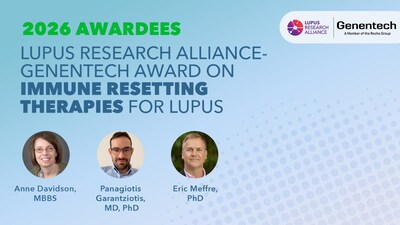
NEW YORK, May 26, 2026 /PRNewswire/ -- Today, the Lupus Research Alliance (LRA), the world's largest private funder of lupus research, in collaboration with Genentech, a member of the Roche Group, announced the inaugural recipients of the Lupus Research Alliance-Genentech Award on Immune Resetting Therapies for Lupus (LGA-IRT). The new program aims to deepen our understanding of engineered cell therapies, an emerging approach that reprograms and resets the immune system, with the potential to induce long-lasting remission in people with lupus.
This year's recipients will be exploring chimeric antigen receptor (CAR)-T cell therapy. This is an approach that has shown remarkable success in oncology and is now being studied in people with severe lupus. In ongoing clinical trials, some lupus patients treated with CD19-targeted CAR-T cells who had not responded to standard treatments experienced rapid, deep remission, allowing them to stop all other lupus medications. CAR-T cell therapy works by reprogramming a person's own immune cells (T cells) to target and eliminate B cells, which play a central role in lupus.
While promising, these dramatic clinical results have also raised important scientific questions about how exactly CAR-T cell therapy "resets" the immune system, why some patients stay in remission longer than others, and whether the disease could return. The program recipients seek to answer those questions.
"Moving from early breakthrough clinical trials to effective therapies requires a strong scientific foundation," said Teodora Staeva, PhD, Chief Scientific Officer of the Lupus Research Alliance. "By supporting these studies with our long-standing partner Genentech, we are deepening our understanding of immune reset to ultimately make these therapies safer and more durable for people affected by this devastating disease."
The program awards $150,000 per year for up to two years, as each researcher aims to advance the development of effective, accessible immune-resetting therapies for people living with lupus.
The three funded projects complement each other, digging deeper to give the scientific community a clearer understanding of this potential therapeutic area. They are:
- Anne Davidson, MBBS, The Feinstein Institutes for Medical Research
- CAR-T cell therapy can lead to long-lasting remission in lupus, but it is not yet clear how it works at a cellular level or why some patients relapse. Dr. Davidson will use mouse models of lupus to investigate two key possibilities that may limit the long-term success of B cell-depleting therapies. First, whether some antibody-producing cells (called plasma cells), which do not express the CAR-T target CD19, survive treatment. Second, whether underlying inflammation persists or re-emerges after therapy. By understanding the immune conditions that lead to either sustained remission or relapse, this research aims to deepen our understanding of lupus and help improve future treatment strategies.
- Panagiotis Garantziotis, MD, PhD, Uniklinikum Erlangen
- CD19-targeted CAR-T cell therapy has shown remarkable success, producing significant B cell depletion and, in some cases, drug-free remission. Dr. Garantziotis will study blood and bone marrow samples from patients treated with CAR T cells and compare them to those receiving standard B cell-targeting therapies over the course of a year. The goal is to better understand how CAR-T cell therapy reshapes, or "resets" the immune system. Insights from this work could help explain why CAR-T cell therapy is so effective and guide the development of safer, more precise treatments for individuals with difficult-to-treat lupus.
- Eric Meffre, PhD, Stanford University
- In a healthy immune system, B cells that produce autoantibodies are usually eliminated through a process called immune tolerance, which prevents the body from attacking itself. In lupus, this safeguard fails, allowing these harmful self-reactive B cells to persist. Evidence suggests that CAR-T cell therapy may help restore this tolerance after removing existing B cells, but how this happens is not fully understood. Dr. Meffre will investigate whether CAR-T cell therapy truly fixes this problem at its source (so the immune system stops generating harmful B cells) or instead works by strengthening control mechanisms that keep these cells in check after they appear. By clarifying how CAR-T cell therapy restores immune balance, this work could help guide strategies for achieving longer-lasting remission in lupus.
To learn more about the program and the projects the Lupus Research Alliance is funding, visit here.
About Lupus
Lupus is a chronic, complex autoimmune disease that affects millions of people worldwide. In lupus, the immune system, meant to defend against infections, produces autoantibodies that mistake the body's own cells as foreign, causing other immune cells to attack organs such as the kidneys, brain, heart, lungs, and skin, as well as blood and joints. Ninety percent of people with lupus are women, most often diagnosed between the ages of 15-45. Black, Latinx, Indigenous, Asian and Pacific Islander people are disproportionately affected by lupus.
About the Lupus Research Alliance
The Lupus Research Alliance is the largest non-governmental, non-profit funder of lupus research worldwide. The organization aims to transform treatment by funding the most innovative lupus research, fostering scientific talent, and driving discovery toward better diagnostics, improved treatments and, ultimately, a cure for lupus. Because the Lupus Research Alliance's Board of Directors funds all administrative and fundraising costs, 100% of all donations go to support lupus research programs.
For more information or to donate to lupus research, visit the LRA at LupusResearch.org and on social media at: X, Facebook, LinkedIn, and Instagram.

 View original content to download multimedia:https://www.prnewswire.com/news-releases/lupus-research-alliance-and-genentech-fund-researchers-translating-car-t-success-into-durable-lupus-treatments-302780420.html
SOURCE Lupus Research Alliance