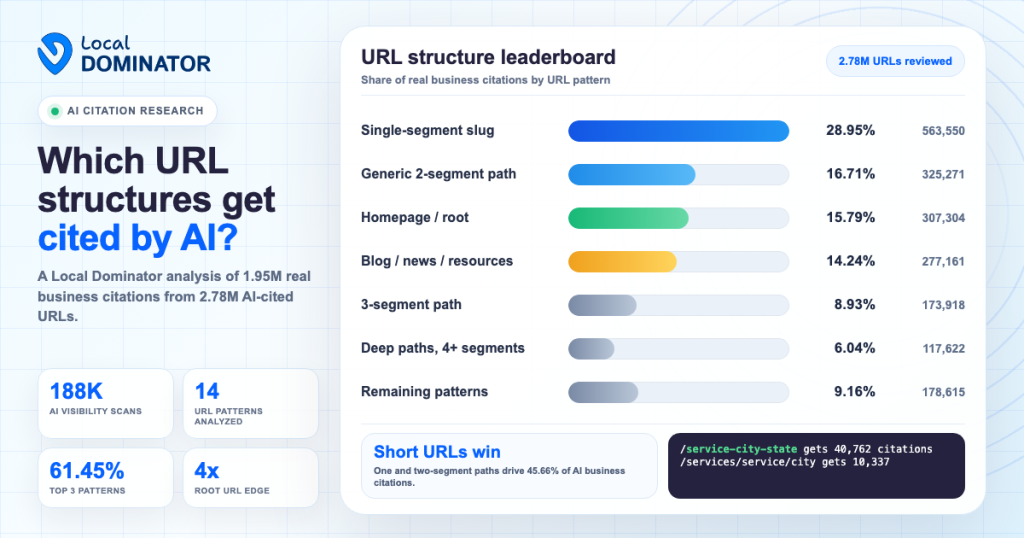
Local Dominator, a local-SEO and AI-search visibility platform, today released research showing that short, single-segment URLs account for nearly 29% of citations across six major AI search engines, more than any other web address format tested. The analysis reviewed 2.78 million AI-cited source URLs drawn from 188,000 AI visibility scans, giving local businesses and marketing agencies data-backed guidance on a structural debate that has divided SEO practitioners for years.
The dataset, filtered down to 1.95 million citations from real business websites, found that homepages generated 15.79% of citations and blog or resource content produced 14.24%, meaning URL types many businesses treat as secondary are shaping how AI engines answer customer questions. Root-level service-and-city addresses, such as a plumber's page for a specific city, outperformed deeply nested service-category pages by a wide margin, a gap Local Dominator says should influence how local businesses plan their site architecture going into 2027. The research tracked citation patterns across ChatGPT, Gemini, Google AI Mode, Perplexity, Claude, and Grok, the six AI-driven platforms Local Dominator's AI Tracker monitors for brand visibility.

"This data confirms something we've suspected for a while: AI engines reward clarity over complexity," said Eldar Cohen, founder of Local Dominator. "The businesses winning AI citations aren't necessarily the ones with the most sophisticated site architecture. They're the ones that make their most important pages easy to find and easy to understand."
Local Dominator surfaced the pattern using data from its AI Tracker, an AI visibility tracking tool that monitors brand citations across AI search engines and flags which of a business's pages are being cited or overlooked. The company says the research is part of an ongoing effort to give agencies concrete benchmarks for AI-era site structure, rather than relying on traditional SEO conventions that predate generative search.
Based on the findings, Local Dominator recommends that local businesses keep high-intent commercial pages short and close to the root domain, using formats such as a single service-and-city slug rather than a multi-folder path. The company also points to the strength of homepages and blog content in the dataset as a sign that businesses should treat both as authority assets rather than secondary pages, particularly as AI-driven discovery continues to take share from traditional search clicks.
The research adds to Local Dominator's broader body of work on how AI systems are reshaping local search, including the zero-click search shift that has moved a growing share of queries away from traditional website clicks and toward direct AI-generated answers.
Local Dominator is a local-SEO and AI-search visibility platform built by a team of agency veterans and local-SEO pros. It helps marketing agencies and local businesses track and improve how they rank across Google Maps, search results, and AI answer engines from one dashboard, with rolling credits, bulk actions, and transparent, no-hidden-fee pricing.
###
Media Contact:
Local Dominator Press Team
(910) 597-0730
team@localdominator.co
Facebook: https://www.facebook.com/LocalDominator
Instagram: https://www.instagram.com/local.dominator/
YouTube: https://www.youtube.com/@LocalDominator
LinkedIn: https://www.linkedin.com/company/local-dominator/
newsroom: news.38digitalmarket.com
Source: 38 Digital Market News
Release ID: 2529522
Source published by Submit Press Release >> Local Dominator Data Shows AI Engines Favor Short URLs