
IT Support Tiers - Expert Insights By Leading Salt Lake City IT Services Provider
Salt Lake City, United States - June 10, 2025 / Protek Support - Managed IT Services Company Salt Lake City /

IT Services Provider in Salt Lake City Explains The Different IT Support Tiers
IT support tiers differ based on the types of issues they solve and the expertise required. Simple problems are handled at lower tiers, while complex issues go to higher-tier experts. This system is a way to expedite responses and keep support staff focused on what they are best at.
Both of these goals are crucial in today’s market. CloudSecureTech notes that 82% of consumers expect IT support technicians to resolve their issues within the first call. Furthermore, customer satisfaction peaks at 84.7% when call response times are between 5 and 10 seconds.
So, let’s take a closer look at why organizing your service desk into 5 levels of support can help you achieve this goal. As an experienced IT services provider in Salt Lake City, we’ll also explore the additional benefits of IT support tiers and show you which issues are ideally solved at which tier.
Different IT Support Tiers Explained
Tier 0 Support
Tier 0 provides self-service options, including frequently asked questions, knowledge bases, and automated support tools, such as chatbots. This level of support empowers users to independently resolve their own issues. In fact, 67% of users prefer this type of support system over speaking to live agents.
Tier 1 Support
Tier 1 is the first point of human contact for users. Tier 1 agents resolve straightforward issues and document details for any problems requiring additional expertise. Examples of such issues may include password resets or basic troubleshooting.
Tier 2 Support
At Tier 2, specialized technicians manage more complex technical problems. Tier 2 agents have access to advanced tools and resources to address recurring or moderate-level challenges. They bridge the gap between basic support and higher-level troubleshooting.
Tier 3 Support
Tier 3 support involves senior technicians or experts who handle advanced technical issues that demand comprehensive troubleshooting and root cause analysis. This tier provides in-depth solutions for complex problems, often implementing custom fixes when lower levels cannot resolve the issue.
Tier 4 Support
Tier 4 includes external vendors or specialized partners who address problems requiring proprietary solutions, complex diagnostics, or warranty-based repairs. This tier is utilized when an issue requires expertise or resources outside the tech support team’s capabilities.
Which Issues Are Best Handled By Each IT Support Tier?
The following table outlines common examples of issues typically resolved at each level of IT support. However, some crossover exists, and it can vary depending on how your technical support team structures their system. For example, a network issue might be handled by tier 2 support in one organization, while another team may escalate it to tier 3.
| Support Level | Examples of Issues Handled |
| Level 0 |
|
| Level 1 |
|
| Level 2 |
|
| Level 3 |
|
| Level 4 |
|
Key Benefits of Separating Services Into Differing Tiers of IT Support
Resource Allocation
Separating tasks by tier allows organizations to direct their most experienced IT professionals to complex challenges instead of basic troubleshooting. This method optimizes resource use, as routine inquiries are handled by tier 1 support, and higher-level staff are free to focus on more demanding tasks.
Training & Specialization
Tiered IT support allows for specialized training programs that align with each tier’s responsibilities. This targeted approach builds a team with varied skills suited to the complexity of tasks in each tier. As a result, staff gain in-depth expertise relevant to their tier, which makes their responses faster and more accurate.
Faster Resolution Times
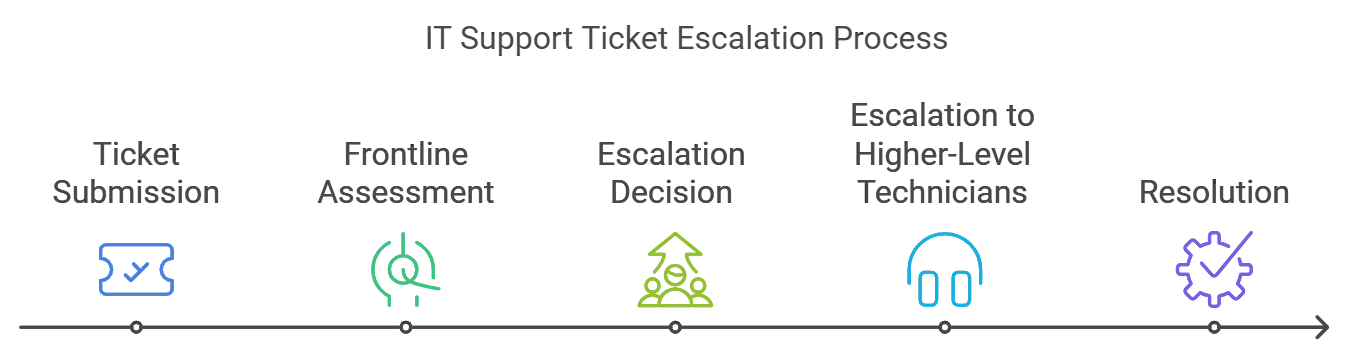
Organizing support requests into tiers helps streamline ticket management, which reduces response and resolution times. With a clear path for escalating issues, simpler inquiries are resolved quickly in the lower tiers, while more complex problems move directly to advanced support.
Cost Efficiency
The tiered support structure reduces operational expenses by distributing tasks effectively among staff. Routine issues handled by tier 1 prevent higher-level staff from being pulled into basic tasks, which lowers overall labor costs.
Enhanced Customer Service
Tiered support improves customer satisfaction by delivering a more personalized and efficient service experience. Users with simple inquiries get immediate assistance from lower-tier support, while more complex issues are escalated seamlessly. This structure leads to better service quality and quicker solutions.
Improved Incident Tracking
Tiered support structures make it easier to monitor and analyze incidents across different levels. Therefore, you’ll gain clearer insights into common issues and areas that may need improvement. This organized tracking helps your team identify trends, optimize workflows, and address recurring problems more effectively.
Outsource to an IT Services in Salt Lake City that Offers All 5 IT Technical Support Tiers
You may or may not need all 5 tiers of IT support to effectively solve your technical challenges. That’s why understanding the difference between these tiers can help you make an informed decision if you decide to outsource your IT support.
However, if you do need all 5 tiers, you can count on Protek Support to provide them. Alongside efficient IT support, we also provide comprehensive managed IT services, network monitoring, and cybersecurity solutions. Our goal is to reduce the number of times you need to call while offering quick problem-solving if you need it.
Reach out today to learn more about how our Salt Lake City IT services can help your business run more smoothly, securely, and efficiently.


Contact Information:
Protek Support - Managed IT Services Company Salt Lake City
299 S Main St #1300
Salt Lake City, UT 84111
United States
Eric Woodard
(844) 796-1717
https://proteksupport.com/


Original Source: https://proteksupport.com/what-is-the-difference-between-it-support-tiers/